
Jurjen Koning
Artikel
24 apr 2026
SPICED CRM Implementation: The Complete Guide
If you've ever sat through a pipeline review where the forecast changed by 40% from one week to the next, you already know the problem: most CRMs track activity, not qualification state. Reps write free-text notes in "Situation" or "Pain" and move deals forward on instinct. Stage-percentage forecasting ("Discovery = 10%, Proposal = 40%") is calibration theater that nobody believes. This guide covers the full fix — Winning by Design's SPICED framework implemented as a typed, computable CRM schema with a deterministic forecasting formula, hard stage gates, and analytics that extend past Closed Won into Recurring Value and Lifetime Value.
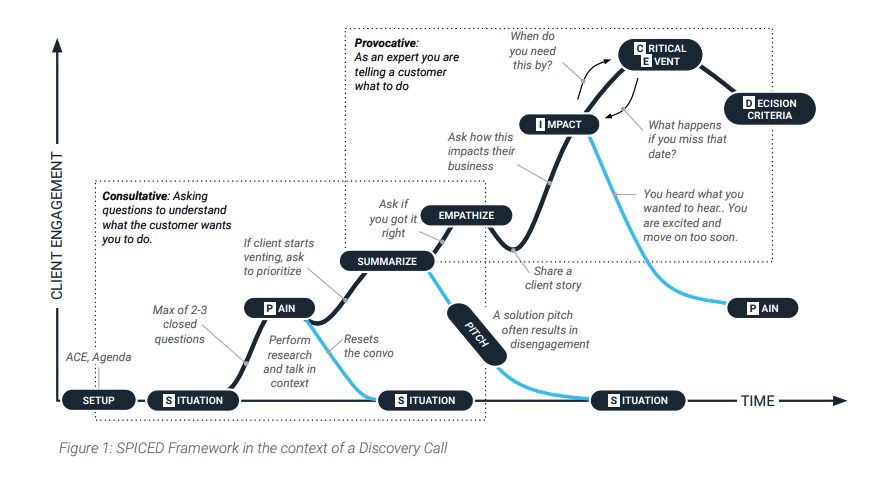
What is SPICED?
SPICED is Winning by Design's sales qualification framework, built specifically for recurring revenue businesses. It stands for:
S — Situation: facts and circumstances about the customer's world
P — Pain: the problem they have or the opportunity they see
I — Impact: the measurable result of solving the pain
CE — Critical Event: a deadline with tangible consequences
D — Decision: who decides, how they decide, and the criteria they use
Where it diverges from older frameworks is the schema. SPICED isn't a notes template for call prep — it's meant to be implemented as typed CRM attributes (narrative text + scored picklist per dimension), fed into a forecasting formula, enforced by stage-gate automations, and extended past Closed Won into CS territory.
SPICED vs MEDDIC
MEDDIC was built for hardware and perpetual-license software sales. Its center of gravity is the close: Metrics, Economic Buyer, Decision Process, Decision Criteria, Paperwork, Identify Pain, Champion.
SPICED is built for SaaS and services. Its center of gravity is recurring impact. The decision isn't "Do we have the budget?" — it's "Is this a priority?" with priority being the outcome of the Impact. Hence SPICED adds Situation (recurring businesses care deeply about fit) and Critical Event (priority is driven by time pressure) as first-class fields.
The Core Architecture: Text + Score Pairs
Every SPICED dimension gets two attributes on the Opportunity record:
A long-text field (32,768 chars) — the narrative for humans
A picklist field (0-3 scale) — the score for machines
The text lives for reps, managers, and handoff docs. The score lives for the forecast model, stage-gate validation, pipeline dashboards, and CS handoff. Same principle applies to post-sale: First Value, Recurring Value, and Lifetime Value are checkbox + date pairs, not Slack messages.
The Complete Schema
Here's every attribute you need, with picklist values taken from Winning by Design's canonical Tech Integration spec.
1. Situation — Is the account a fit?
Score | Description |
|---|---|
0 | Unknown / Still Researching |
1 | Not a Target Account |
2 | Matches Target ICP |
3 | Matches ICP Exceptionally Well |
2. Pain — Has a pain we can solve?
Score | Description |
|---|---|
0 | Unknown / No Pain Identified |
1 | Scope Somewhat Aligned |
2 | Pain(s) Identified |
3 | Acute Pain Identified |
3. Impact — Can we quantify the business impact?
Score | Description |
|---|---|
0 | No impact tied to revenue/cost/knowledge |
1 | Soft cost savings (hours) |
2 | Quantifiable Impact Identified |
3 | Acute Impact (>10% of business) |
Plus Emotional Impact as a 255-char text field on every Contact Role — different per role (Champion, Gatekeeper, User, Influencer).
4. Critical Event — Do they have a deadline with consequences?
Score | Description |
|---|---|
0 | Unknown / Still Researching |
1 | Exploration (RFI only) |
2 | Compelling Event (vague mandate) |
3 | Critical Event (specific date + consequences) |
Plus critical_event_date (ISO8601 YYYY-MM-DD), required when Score ≥ 2.
5. Decision — Split into three fields
Decision is the only SPICED element that splits into multiple attributes because the evaluation committee isn't the contract committee.
Decision Process — Evaluation (text): how decisions get made during evaluation. Map the buying committee + priority criteria.
Decision Process — Contract (text): how decisions get made at contract. Legal, security, procurement, signing authority.
Decision Criteria (text): the customer's criteria, ranked vs alternatives.
Decision Process Score (picklist): decision-maker count
Score | Description |
|---|---|
0 | Unknown |
1 | ≥1 Decision Maker |
2 | ≥3 Decision Makers |
3 | ≥5 Decision Makers |
Decision Criteria Score (picklist): depth of criteria understanding
Score | Description |
|---|---|
0 | Unknown |
1 | Known Decision Criteria |
2 | Impact of Criteria Known |
3 | Ranking vs. Alternatives Known |
The Forecasting Formula
This is where SPICED departs from stage-percentage forecasting. Two formulas for two use cases:
Formula 1: Normalized Opportunity Score (0-100)
$$\text{Opportunity Score} = \frac{(S \times P \times I) + 1.5 \times (CE \times DP \times DC)}{6.75}$$
Max raw value = 3³ + 1.5·3³ = 67.5. Divide by 6.75 → 0-100 scale.
Why the 1.5× weight on the Decision side: without a critical event, known decision process, and clear criteria, deals slip regardless of how strong fit, pain, and impact look. The formula punishes deals that have great narrative but no close path.
Formula 2: Natural Probability (log-scale)
$$P_N(x) = \frac{S_{\text{bin}} \times P_{\text{bin}} \times \text{Impact}^{CE}}{DC}$$
Using a 0 / 1 / 3 / 7 scaling for Impact, CE, and DC. Critical Event acts as the exponent on Impact — which matches how closing probability actually moves (non-linear, with CE dramatically amplifying or collapsing the deal's odds).
Use normalized 0-100 for dashboards. Use Natural Probability for forecast intuition.
Why this beats stage-percentage forecasting
Stage percentages assume every deal at a given stage has the same close probability. They don't. A Stage 4 deal with no Critical Event and one DM is nothing like a Stage 4 deal with an acute CE and 5 aligned DMs.
SPICED forecasting is:
Multiplicative — a zero anywhere collapses the score. You can't fake readiness.
Stage-agnostic — a Stage 2 deal with S=3, P=3, I=3 can score higher than a Stage 5 deal with P=0.
Auditable — every score has a text narrative. Managers coach the gap, not the number.
Exponential on CE — matches buyer reality. No critical event, no close.
The 7-Stage Bowtie Pipeline
SPICED is inseparable from Winning by Design's bowtie pipeline architecture. The bowtie has 7 pre-sale stages, 4 post-sale stages, and Closed Lost.
Pre-sale:
Stage | Required SPICED to enter |
|---|---|
1. Conversation | Situation (text) |
2. Diagnose | Pain + Pain Score ≥ 1 |
3. Workshop | Impact + Impact Score ≥ 2 |
4. PoC | Critical Event + CE Score ≥ 2 + CE Date |
5. Propose | DP-Evaluation + DP Score ≥ 1 + DC Score ≥ 1 |
6. Trade | DP-Contract + DC Score ≥ 2 |
7. Commit (Closed Won) | All above + Close Reason Comment |
Post-sale (CS territory):
Stage | What it represents |
|---|---|
8. Onboard | Implementation phase |
9. Achieve Impact | First Value Achieved |
10. Recurring Value | Recurring Value Achieved |
11. Growth | Expansion, expected vs. actual impact tracked |
Closed Lost is a terminal side-exit from any pre-Commit stage. Requires Close Reason + Close Reason Comment (hard-enforced by automation).
Stage progression rules
Forward-only: advance one stage at a time. Skipping ≥2 stages requires manager override.
No regression: if a deal won't close, move to Closed Lost with reason + comment. Open a new Opportunity later.
CE Date watchlist: if
critical_event_date < TODAY()and stage < Commit → automation creates task "CE date passed — revisit or close."
Beyond the Sale: SPICED Through Lifetime Value
The same SPICED schema carries past Closed Won into CS. Sales promised an Impact — CS measures whether you delivered. This is what the bowtie is actually about.
Criteria | PROSPECT | MQL | SQL | SAL | WIN | LIVE | ARR | LTV |
|---|---|---|---|---|---|---|---|---|
Is a fit? (S) | ✓ | ✓ | ✓ | ✓ | ✓ | ✓ | ✓ | ✓ |
Has a pain? (P) | ✓ | ✓ | ✓ | ✓ | ✓ | ✓ | ✓ | |
Can we impact? (I) | ✓ | ✓ | ✓ | ✓ | ✓ | ✓ | ||
Critical Event? (CE) | ✓ | ✓ | ✓ | ✓ | ✓ | |||
Mutual commitment? (D) | ✓ | ✓ | ✓ | ✓ | ||||
First Value achieved? | ✓ | ✓ | ✓ | |||||
Recurring Value achieved? | ✓ | ✓ | ||||||
Total Lifetime Value achieved? | ✓ |
Top 5 rows = pre-sale SPICED. Bottom 3 = post-sale extension. CS owns the bottom 3. The gap between promised Impact (sales) and actual Impact (CS) becomes a quarterly metric and fires expansion workflows when recurring_value_achieved = true.
The Decision Roles Map
Each person in the buying committee primarily surfaces one SPICED signal:
Role | Primary SPICED Signal |
|---|---|
Initiator | Pain |
User | Emotional Impact |
Champion | Rational Impact |
Decision Maker | Critical Event |
Gatekeeper | Emotional Impact |
Influencer | Emotional Impact |
Executive Buyer | Decision Criteria |
Tag Contact Roles accordingly. Now you can query "show me all deals where no Decision Maker has been identified" — something free-text notes can't do.
Decision Sentiment Ladder
Sentiment | SPICED Signal | Meaning |
|---|---|---|
Loves Us | Emotional Impact | Public advocate |
Positive | Rational Impact | Private proponent |
Neutral | NULL | Status quo possible |
Unknown | NULL | Position unclear |
Negative | [-] Rational Impact | Not favoring |
Enemy | [-] Emotional Impact | Favoring competitor |
Implementation on Attio, HubSpot, or Salesforce
SPICED is a schema pattern, not a tool choice. We've built it on Attio; Winning by Design published a reference Salesforce implementation in April 2023; HubSpot follows the same pattern.
Minimum viable implementation (Tier 1)
Create 6 Score picklists on Opportunity with the values above
Keep existing free-text fields for the narrative side
Split the Decision text field into 3 (Evaluation, Contract, Criteria)
Add
critical_event_date(ISO date, required when CE Score ≥ 2)Rename pipeline stages to the 7-stage bowtie model
Add Persona + Decision Role + Emotional Impact on Contact/Person
Compute Opportunity Score via automation (on every field update)
Tier 2 adds: measurement + guidance
Stage-gate validation (block advance without required fields)
Relevance Tier cascade (auto-sets 01 Not Relevant → 05 Urgent)
Bowtie conversion dashboards (CR1-CR8)
Stuck Deals + CE Watchlist views
Tier 3 adds: AI coaching
Call-recording writeback (Fireflies/Gong → Claygent → SPICED Scores)
Pre-call Situation population via Clay
Close-loss AI analysis (human-reported vs AI-reported divergence)
The 6-Week Implementation Sprint
Week | Focus |
|---|---|
1 | Schema foundation — picklists, decision split, CE Date, computed fields, close reasons |
2 | People + post-sale attributes + pipeline rename + data migration (Claygent-assisted backfill) |
3 | Forecasting engine — Opp Score automation, Relevance Tier cascade, Natural Probability |
4 | Stage gates + bowtie analytics (CR1-CR8, Time-in-Stage, Stuck Deals, CE Watchlist) |
5 | Intelligence integration — call writeback, Cal.com extension, close-loss AI |
6 | Enablement — rep cheat sheet, 2× training, manager enablement, ops handoff |
The KPI Set
What to track weekly once this is live:
Metric | Target |
|---|---|
SPICED fill rate by Stage 5 | 95%+ |
Forecast accuracy (50+ deals) | ±15% |
Stage-gate compliance (post-Week 6) | 100% |
Close reason completeness | 100% |
Pre→post-sale handoff (First Value within 30d) | 80%+ |
Quality gates:
Tier 1 done: every new Deal in next 30 days has all 6 Scores by Stage 5
Tier 2 done: Opp Score correlates with win rate within 15% over 50+ deals
Tier 3 done: ≥80% of SPICED updates originate from call-recording writeback
Source Documents
This guide synthesizes three canonical Winning by Design publications:
SPICED Tech Integration (Amanda Naso, Oct 2022) — the technical CRM field specification
SPICED Implementation (Winning by Design) — the framework fundamentals + bowtie mapping + forecasting formulas
Salesforce Sample SPICED Guide (April 2023) — reference build with field API names, picklists, validation rules, Process Builder automations
Frequently Asked Questions
What is SPICED in sales?
SPICED is Winning by Design's sales qualification framework designed for recurring revenue businesses. It stands for Situation, Pain, Impact, Critical Event, and Decision. Unlike older frameworks like MEDDIC, SPICED is built to extend through the full customer lifecycle — not just the deal close — and is designed to be implemented as a typed CRM schema rather than a notes template.
What is the SPICED forecasting formula?
The normalized Opportunity Score formula is (S × P × I + 1.5 × CE × DP × DC) / 6.75, producing a 0-100 value. The 1.5× weight on the Decision side reflects that without a critical event, known decision process, and clear criteria, deals slip regardless of fit, pain, and impact strength. There's also a Natural Probability formula using a 0/1/3/7 log-scale with CE as an exponent on Impact.
How is SPICED different from MEDDIC?
MEDDIC focuses on closing the deal (Metrics, Economic Buyer, Decision Process, Decision Criteria, Paperwork, Identify Pain, Champion). SPICED focuses on recurring impact and adds Situation + Critical Event as first-class fields. In recurring revenue, priority matters more than budget — SPICED reflects that.
What are the 7 stages of the SPICED bowtie pipeline?
Conversation → Diagnose → Workshop → PoC → Propose → Trade → Commit. Each stage requires specific SPICED fields populated before a deal can advance. After Commit, the bowtie continues into Onboard → Achieve Impact → Recurring Value → Growth.
Can I implement SPICED in Attio, HubSpot, or Salesforce?
Yes. SPICED is a schema pattern, not a tool. Each platform needs the same 6 typed attributes per Opportunity (narrative text + scored picklist pair) plus a 7-stage pipeline with stage-gate automations. Winning by Design published a reference Salesforce implementation in April 2023; we've built the same pattern on Attio.
Do I need an external webhook for the Opportunity Score to auto-compute?
On Attio: most of the logic (Relevance Tier, milestone, post-sale flags) works in native Automations. The exact 0-100 math requires either a webhook or a daily cron. On Salesforce, formula fields handle the math natively. On HubSpot, custom code-action workflows cover it.
Why use text + score pairs instead of just text notes?
Text notes can't be computed against. You can't build a forecast model on "they have 15 AEs." You can't run stage-gate validation on "does Pain contain enough context." You can't benchmark Pain strength across deals. The score provides the machine-readable layer; the text preserves the narrative for humans. Both matter.
book a call to scope a 6-week SPICED implementation sprint on your CRM.
Jurjen Koning is Head of Go-to-Market at 24Sales. He advises B2B SaaS, vertical software, and industrial companies on intelligence-driven GTM, CRM architecture, and pipeline operating systems.